Boost Surge X Official Website › Blog › Do Testosterone Booster Supplements Work?
Do Testosterone Booster Supplements Work?
- Most ingredients in this category have little or no clinical support at the doses used.
- A 2020 analysis of fifty best-selling products found exactly that, and found overdosing of some nutrients as well.
- Two ingredients have a genuine signal at specific doses; several have none at any dose.
- Sleep, alcohol, body composition and treating an actual deficiency all beat every capsule in this aisle.
- The honest position: if a blood test says your testosterone is low, that is a doctor's appointment rather than a purchase.
This article is published by a website that sells a men's supplement, and it answers the question in its title with a qualified no. That is worth saying at the top rather than burying, because the rest only makes sense if you know where it is going.
The short version: the category as a whole is not supported by the evidence it cites, a couple of ingredients have a genuine signal at specific doses that most products do not use, and the things that actually move testosterone in an adult man are mostly free.
The short answer
"Testosterone booster" is a marketing category rather than a pharmacological one. It describes products that combine botanicals, vitamins and minerals and are sold on the promise of higher testosterone, more energy or better performance.
A dietary supplement may not claim to treat a condition, so the compliant text on these products says things like "supports healthy testosterone levels". The promise of something more is carried by the product name, the photography and the testimonials. Once you see that split, every page in this category becomes easier to read, including this one.
Does the category work? For a man with a diagnosed deficiency, no: that is a medical condition with a medical treatment. For a healthy man in the normal range, the honest answer is that most products contain too little of the few things with evidence behind them for anyone to say.
What happened when someone checked fifty of them
The best single piece of work on this question is Clemesha 2020, published in the World Journal of Men's Health. The full text is open access at the open-access text.
The authors took the fifty best-selling testosterone-boosting supplements, catalogued every ingredient, and searched the literature for evidence supporting each one at the amounts used. Three findings are worth carrying away.
- Most ingredients had little or no supporting clinical data at the doses in the products.
- A substantial share of products contained amounts of vitamins and minerals well above the recommended daily intake, which is a quantity problem in the opposite direction from the botanicals.
- The marketing claims consistently outran what the ingredient evidence could support, which is the central finding and the reason the paper exists.
That is an analysis of the category, not of any one product, and it is the single most useful thing to read before buying anything in this aisle.
Ingredient by ingredient
Here is the honest state of the recurring names, without reference to any brand.
| Ingredient | The case for it | The case against |
|---|---|---|
| Tongkat ali | The strongest in the category. Talbott 2013 at 200 mg a day for four weeks reported lower cortisol and higher testosterone. | Small, short trials of mixed quality, per a 2017 systematic review. Most products contain a fraction of the studied dose. |
| Boron | Naghii 2011 reported a hormonal shift at 10 mg a day in healthy men. | A very small, week-long study. And the NIH Office of Dietary Supplements sets the adult upper intake level at 20 mg a day from all sources, so quantity matters. |
| Saw palmetto | Widely studied, and the studies are good quality. | the Cochrane review and the CAMUS trial both found no benefit over placebo, even at three times the usual dose. |
| Nettle root | Safarinejad 2005 reported improved urinary symptoms at 360 mg a day over six months. | A prostate result rather than a testosterone one, and the review literature is more cautious. |
| Horny goat weed | Dell'Agli 2008 found potent phosphodiesterase-5 inhibition by icariin derivatives. | In vitro, on isolated and in some cases chemically modified molecules. No human dose for the herb is established. |
| Wild yam | Diosgenin is genuinely a starting material for industrial steroid synthesis. | The human body does not perform that conversion, and Komesaroff 2001 found no hormonal effect in a controlled trial. |
| Sarsaparilla | Tian 2017 catalogues real steroidal saponins in the genus. | No controlled human trial for vitality. A steroidal saponin is not a steroid hormone. |
Two ingredients have a real signal at a specific dose. Two have good evidence that they do not do what the category says. Three have no human dose established at all.
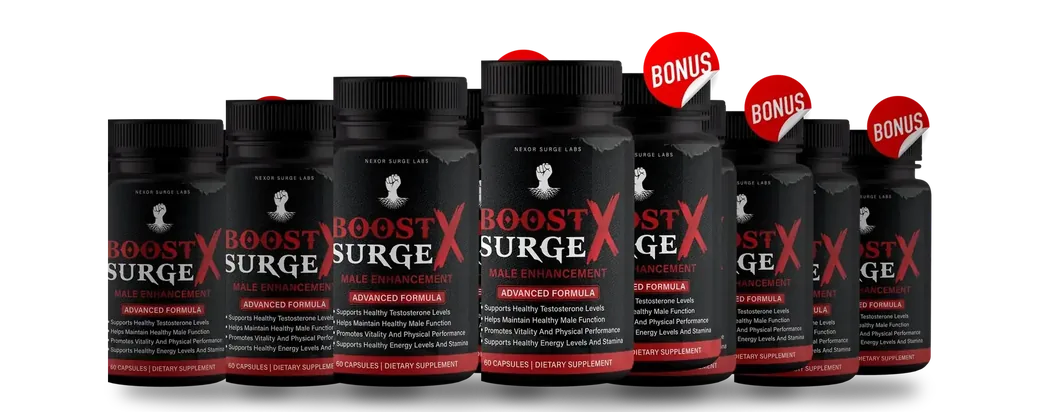
Order Boost Surge X knowing what the category is
Seven named botanicals with every amount printed, sold with a 180-day window. Read the ingredients page first and decide with the numbers in front of you.
$354 for 6 + 2 bottles, $44.25 each
Order Boost Surge X On The Official Website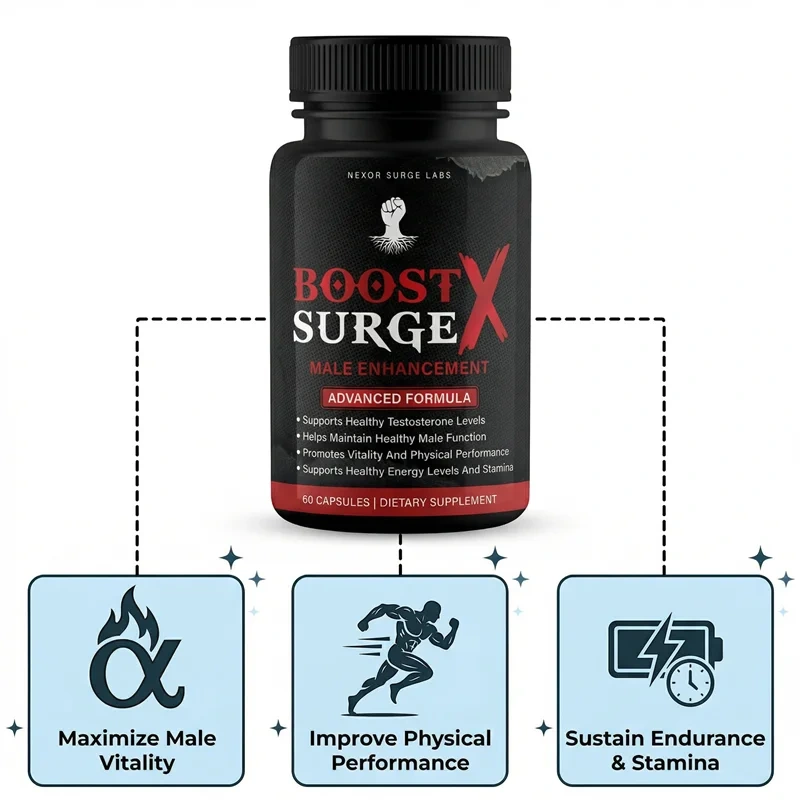
What does move testosterone
This is the section a supplement website is not supposed to write, and it is the most useful one.
- Sleep. Testosterone is largely produced during sleep. Restricting sleep to five hours a night measurably lowers daytime testosterone in healthy young men within a week. Nothing in any capsule competes with two extra hours a night.
- Body composition. Adipose tissue converts testosterone to oestrogen. Losing excess body fat raises testosterone in men who have it to lose, reliably and by a margin no botanical approaches.
- Alcohol. Heavy regular intake lowers it. This is unwelcome and it is consistent.
- Resistance training. Modest and real, and it improves almost everything else people in this category are actually looking for.
- Treating an actual deficiency. If a morning blood test shows low testosterone, that is a medical pathway with an effective treatment, and a capsule is a delay rather than an alternative.
- Correcting a real nutrient gap. If you are genuinely deficient in vitamin D or zinc, correcting it helps. If you are not, supplementing them does nothing for testosterone.
Every item on that list is free or cheap, and none of it is as interesting as a bottle. That is the whole commercial problem with honest advice in this market.
It is also worth being clear about the size of the effects involved. Correcting several hours of chronic sleep debt, or losing a meaningful amount of excess body fat, produces changes in measured testosterone that no botanical in this category has ever demonstrated at any dose. A supplement is at best a small addition on top of those, and it is never a substitute for them. Anyone selling it as a shortcut past the list above is selling you something the evidence does not support.
Why people feel better anyway
Plenty of people take one of these products and report feeling better. That is real experience, and there are several explanations for it that do not require the capsule to be doing anything.
Regression to the mean. People buy a supplement when they feel worst. Feeling worst is usually a temporary state, and things improve from a low point whether or not anything is taken.
Expectation. Placebo effects on subjective outcomes such as energy and mood are large and well documented. That does not make the feeling fake; it makes attributing it to the capsule unreliable.
The behaviour around the capsule. Someone starting a daily supplement at the same meal each day is frequently also eating more regularly, drinking less and paying more attention to sleep. Those changes are doing work the bottle gets credit for.
Time. A product with an eight-week onset gets eight weeks of ordinary life attributed to it, including a holiday, a good training block or a resolved stressor.
If you are going to buy one
Four rules, which are the short version of the nine-check guide on this website.
- Insist on printed amounts. A proprietary blend cannot be evaluated, and a product you cannot evaluate is a product you are trusting rather than choosing.
- Do the division. Printed amount against studied dose. Anything worse than a third and the citation is decoration.
- Check anything with an upper intake level. Minerals, mostly, and across every product in your cupboard rather than one at a time.
- Check the refund window against the stated timeline. A thirty-day guarantee on a product that claims an eight-week onset is not a guarantee.
And this one
Applying that to Boost Surge X, which is the product this website sells, gives a mixed answer and it is printed in full on the ingredients page.
It passes the first rule: seven named items, seven printed amounts, no proprietary blend. It fails the second: the botanical amounts are between a sixteenth and a twentieth of the studied doses. It raises the third: 20 mg of boron sits on the adult upper intake level and the form is not published. It passes the fourth comfortably: a 180-day window against a three to eight week stated onset.
Two out of four, with the two failures on the side that matters most for whether it works. Anyone reading that and deciding to buy something else has used this article correctly. Anyone reading it and deciding to test a disclosed panel inside a long refund window has also used it correctly. What we are not going to do is tell you the answer is obvious in either direction.
Sources
- Clemesha CG, Thaker H, Samplaski MK. 'Testosterone Boosting' Supplements Composition and Claims Are not Supported by the Academic Literature. World J Mens Health. 2020;38(1):115-122. PMID 31385468. https://pubmed.ncbi.nlm.nih.gov/31385468/
- Clemesha CG, Thaker H, Samplaski MK. 'Testosterone Boosting' Supplements Composition and Claims Are not Supported by the Academic Literature. The World Journal of Men's Health, open access full text. https://www.wjmh.org/DOIx.php?id=10.5534/wjmh.190043
- Talbott SM, Talbott JA, George A, Pugh M. Effect of Tongkat Ali on stress hormones and psychological mood state in moderately stressed subjects. J Int Soc Sports Nutr. 2013;10(1):28. PMID 23705671. https://pubmed.ncbi.nlm.nih.gov/23705671/
- Thu HE, Mohamed IN, Hussain Z, Jayusman PA, Shuid AN. Eurycoma longifolia as a potential adaptogen of male sexual health: a systematic review on clinical studies. Chin J Nat Med. 2017;15(1):71-80. PMID 28259255. https://pubmed.ncbi.nlm.nih.gov/28259255/
- Naghii MR, Mofid M, Asgari AR, Hedayati M, Daneshpour MS. Comparative effects of daily and weekly boron supplementation on plasma steroid hormones and proinflammatory cytokines. J Trace Elem Med Biol. 2011;25(1):54-8. PMID 21129941. https://pubmed.ncbi.nlm.nih.gov/21129941/
- National Institutes of Health, Office of Dietary Supplements. Boron: Fact Sheet for Health Professionals. https://ods.od.nih.gov/factsheets/Boron-HealthProfessional/
- Tacklind J, Macdonald R, Rutks I, Stanke JU, Wilt TJ. Serenoa repens for benign prostatic hyperplasia. Cochrane Database Syst Rev. 2012;12:CD001423. PMID 23235581. https://pubmed.ncbi.nlm.nih.gov/23235581/
- Barry MJ, Meleth S, Lee JY, Kreder KJ, et al. Effect of increasing doses of saw palmetto extract on lower urinary tract symptoms: a randomized trial. JAMA. 2011;306(12):1344-51. PMID 21954478. https://pubmed.ncbi.nlm.nih.gov/21954478/
- Safarinejad MR. Urtica dioica for treatment of benign prostatic hyperplasia: a prospective, randomized, double-blind, placebo-controlled, crossover study. J Herb Pharmacother. 2005;5(4):1-11. PMID 16635963. https://pubmed.ncbi.nlm.nih.gov/16635963/
- Dell'Agli M, Galli GV, Dal Cero E, Belluti F, et al. Potent inhibition of human phosphodiesterase-5 by icariin derivatives. J Nat Prod. 2008;71(9):1513-7. PMID 18778098. https://pubmed.ncbi.nlm.nih.gov/18778098/
- Komesaroff PA, Black CV, Cable V, Sudhir K. Effects of wild yam extract on menopausal symptoms, lipids and sex hormones in healthy menopausal women. Climacteric. 2001;4(2):144-50. PMID 11428178. https://pubmed.ncbi.nlm.nih.gov/11428178/
- Tian LW, Zhang Z, Long HL, Zhang YJ. Steroidal Saponins from the Genus Smilax and Their Biological Activities. Nat Prod Bioprospect. 2017;7(4):283-298. PMID 28646341. https://pubmed.ncbi.nlm.nih.gov/28646341/
Every page, every journal post, the bottle facts and the ingredients go through review by Dr. Kambiz Tajkarimi, MD before they ship. We write from the Boost Surge X label and the distributor’s own batch paperwork, confirm every research record before publishing it, and print “not published” wherever a figure is not disclosed. Corrections go to [email protected] and move the review date forward. Last reviewed September 2026 by Dr. Kambiz Tajkarimi, MD.